
 The use of the word ‘brand’ has become very popular over the last 10 years as there has been an overwhelming increase in digital media marketing of personalities, products and services. Additionally, more trained marketing professionals have been using the term to make their mark while trying to make brands better.
Over time I have noticed that though the use of the term has become commonplace, there is still a misuse and even misunderstanding of what brand building is. I have seen trends being chased and copied, misfit brand ambassador/influencer pairings and other short term tactics posited as brand development methods. I have lots of good work too by marketing professionals carefully crafting brand imprints that foster strong and sustainable share of heart and share of pocket.
During my two decades of engineering brands both from the creative and strategic lanes, I have found that a brand strategy driven by “WHY?” gives any brand a chance to thrive in all seasons along its life cycle and to survive trends that fade after their viral rise. The “Why” of a brand is its essential heartbeat.
First of all, what is a “Brand”?
According to international marketing thought leader, Seth Godin a brand is "the set of expectations, memories, stories, and relationships that, taken together, account for a consumer's decision to choose one product or service over another,"
Brand is what a profit seeking entity is known for. Profit not solely being expressed or perceived from a monetary perspective but from the point of view of value. Profit seeking entities include:
● Businesses- sellers of products and services to target audiences with the goal of earning from audience’s consumption of their offering
● Individuals- sellers of an image or persona which being promoted to gain attention, income, status or any other benefit for that individual
For years I have used this acronym for BRAND to help map a brand’s strategy and to also help train emerging marketers better in understanding that brand-health work is not cosmetic surgery application of trends, but rather the long-term commitment of brand workout and healthy diet strategies.
Sabrena’s definition of “BRAND” ©
B- Building (defining your why, what, how and who; constructing, shaping). Heavy awareness driven campaigns to establish brand positioning and unique selling points. Establishing value adding relevance and justifying value/pricing (Who, Why, What)
R- Reputation (creating evidence/proof). Providing evidence of brand positioning and problem solving truths. Images, testimonials, demos, expos, interviews (Why, Where, When, How)
A- And (continuation, process, growth). Market research and analytics led product and brand development/expansions/extensions/growth (Revisiting the 5ws and 1H)
N- Nurturing (incubate, feed, nurse, cultivate, encourage, nourish). Sponsorships, partnerships, experiential marketing, rewards that make the target audience feel important (Why, How)
D- Dedication (loyalty, repeat usage/ interaction/purchase; willingness to share the good news with others). Testimonials, pre-orders, bulk orders, referrals from the now committed audience who is now an ally. They begin to market the brand on impulse as the brand is part of their lives. (Why, Who)
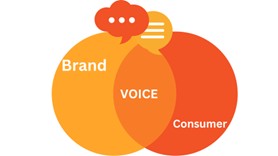
Marketing’s role in branding is to ensure that there is alignment and a wide overlap of the Venn diagram circles of what that entity wants to be known for and what they really are known for. That overlap is the power for the brand’s voice.
Image illustrating the Brand: Consumer Venn Diagram
It is less expensive to maintain a customer than to attract new ones. Marketing and its tools and ingredients must be applied to create and maintain customer relationships beyond current trends- brand now, brand next year, brand three or five years from now.
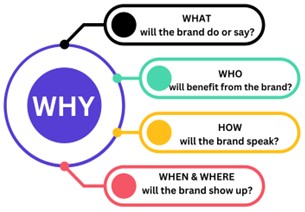
The WHY approach allows for the brand story to always sit in the centre of that overlap between business intent/objectives and target audience desires and experience. It asks the questions as shown on the image below throughout the life of the brand.
Image illustrating Sabrena’s “Why” approach to brand storytelling
Telling relevant brand stories along the Brand Life Cycle
The journey of a brand from development, to introduction, through to growth, then maturity, then decline (or resurrection). The life point of a brand affects how it is marketed/advertised. What is the “why” at that life point- Is it trying to gain market awareness, claim market share, protect market share, reclaim relevance and market share? The answer to these questions will help the brand storyteller to create narratives that pull heart strings and purse strings.
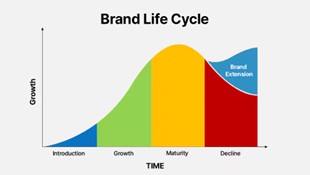
Image taken from https://www.hyosungheavyindustries.com/es/brand/brand-now/journalism/677
4 Steps to positioning the brand's voice for sustained growth:
- seek to know and know the brand’s voice as purpose
- listen to the consumer voice expressed as desires, frustrations and lifestyle
- find/create ways to connect and overlap the brand’s voice with the consumer’s voice
- provide contexts to amplify that connection to provide reasons to believe
When “Why” is at the heart of the marketing strategy, brands win and customers are delighted; and that is the true mission of all brand owners and brand builders.
By Sabrena McDonald Radcliffe- MBA, BA, Dip.Ed